
CREATE ADVENTOR Presents: Dr. Amy LaViers
Date
Friday June 19, 202611:00 am - 12:00 pm
Location
Hybrid- McGill Engine Room FDA5
Join us in person (McGill Engine Room, Montreal, QC), or online for a talk by Dr. Amy LaViers, Director of the Robotics, Automation, and Dance (RAD) Lab.
Amy LaViers, Director, The RAD Lab (she/ her)
Amy LaViers works at the intersection of robotics and dance and is a pioneer in the field she named: choreobotics. Her writing, choreography, and machine designs have been presented internationally in both engineering and arts venues, including Nature, Robotics and Autonomous Systems, the Oxford Handbook of Improvisation in Dance, MIT Press, Merce Cunningham's studios, Joe's Pub at the Public Theater, and the Performance Arcade. Her teaching has been recognized on the University of Illinois at Urbana-Champaign's List of Teachers Ranked as Excellent by Their Students with Outstanding distinction, and she is a recipient of DARPA's Young Faculty Award and Director's Fellowship. Her work has been featured in media outlets like The New York Times, Wired, and Dance Magazine. She lives in Philadelphia where she directs the Robotics, Automation, and Dance (RAD) Lab, a non-profit for artmaking, education, and research.
Choreobotics, Movemes, and a Periodic Table for Choreography
Can a human imitate an octopus? Can a bee mimic a centipede? Can a quadruped mirror a biped? When do two bodies in motion do the same thins? Moving robots out of factories requires that we consider the ability of a body's movement to communicate, express, or otherwise encode meaning. This new context poignantly demonstrates how dance is an essential body of knowledge for robotic research: chemists create compounds, aided by a systematic organization of molecules; musicians make instruments like a cello and glute perform similar actions, bolstered by shared notation. Likewise, dancers take disparate bodies, people with differing bone structures and musculatures, and create coordinated group action in a novel motion style that serves a single expressive goal. Artist-engineer teams in the RAD Lab use movement notation (with the idea of "movemes" as the basic unit) as a basis for projects in robotics, AI and artmaking. The talk presents several projects while grappling with the impossibility of dancing in unison and positing this phenomenon as a fundamental act that forms the basis of embodied communication.
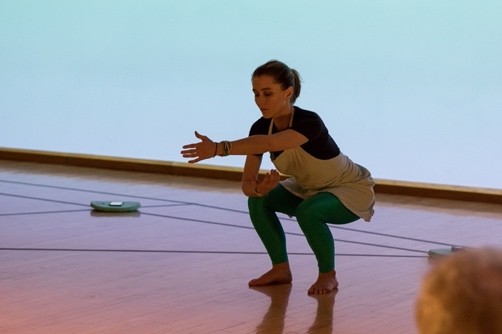
A Machine by The RAD Lab. Performed in DRK at the Krannert Center for Performing Arts in Urbana, IL in December 2018. Amy LaViers dancing with an audience member's cell phone, used to create part of the soundscape for the piece, lying on a labeled cushion. Photo by Natalie Fiol.
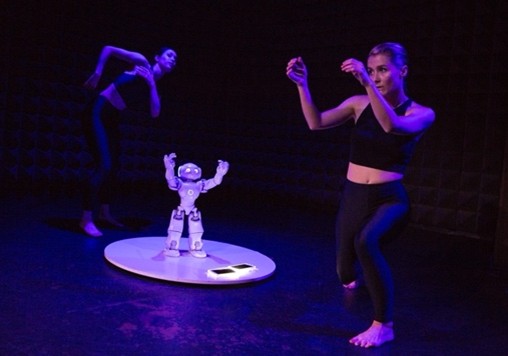
Trio an excerpt of Time to Compile by Catie Cuan x The RAD Lab performed in the DanceNOW Festival at Joe’s Pub at the Public Theater in New York, NY September 2018. Catie Cuan is upstage; Amy LaViers is downstage (in the foreground); and the robot is being controlled by Ishaan Pakrasi offstage. Photo by Yi-Chun Wu.
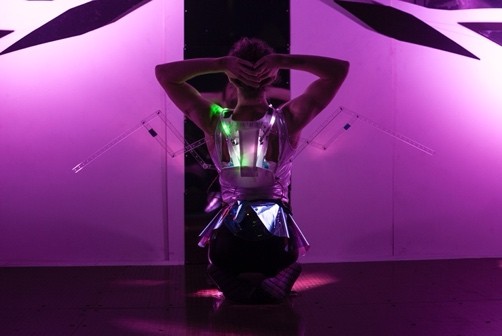
Babyface by Kate Ladenheim x The RAD Lab. Presented at the Performance Arcade in Wellington, NZ in February 2020. Performer Sebastian Geilings of Footnote New Zealand Dance, wearing a pair of breath-activated robotic wings. Photo by Colin Edson.