
Technical Skills Courses
The ADVENTOR Program has designed 6 unique and specialized training modules to equip trainees with the technical skills they need to push the boundaries of their research.
Trainees can expect to engage with ADVENTOR faculty members through discussions, hands-on activities, and interactive lectures on interdisciplinary topics linked to robotic innovation and responsibility within society.
This module begins with the TCPS 2: Core 2022 (Course on Research Ethics) training, where trainees will receive a certificate of completion. The module continues through lectures, case studies, and research experiences on:
- Research Ethics and Protocols
- Research Methods: Working with Children
- Developing Assistive and Persuasive Socially Assistive Robots for Wellbeing and Health of Older Adults
- Mental States in Physical Human-Robot Interaction
Led by: Yue Hu, Valerie Kuhlmeier, Goldie Nejat, Amy Wu
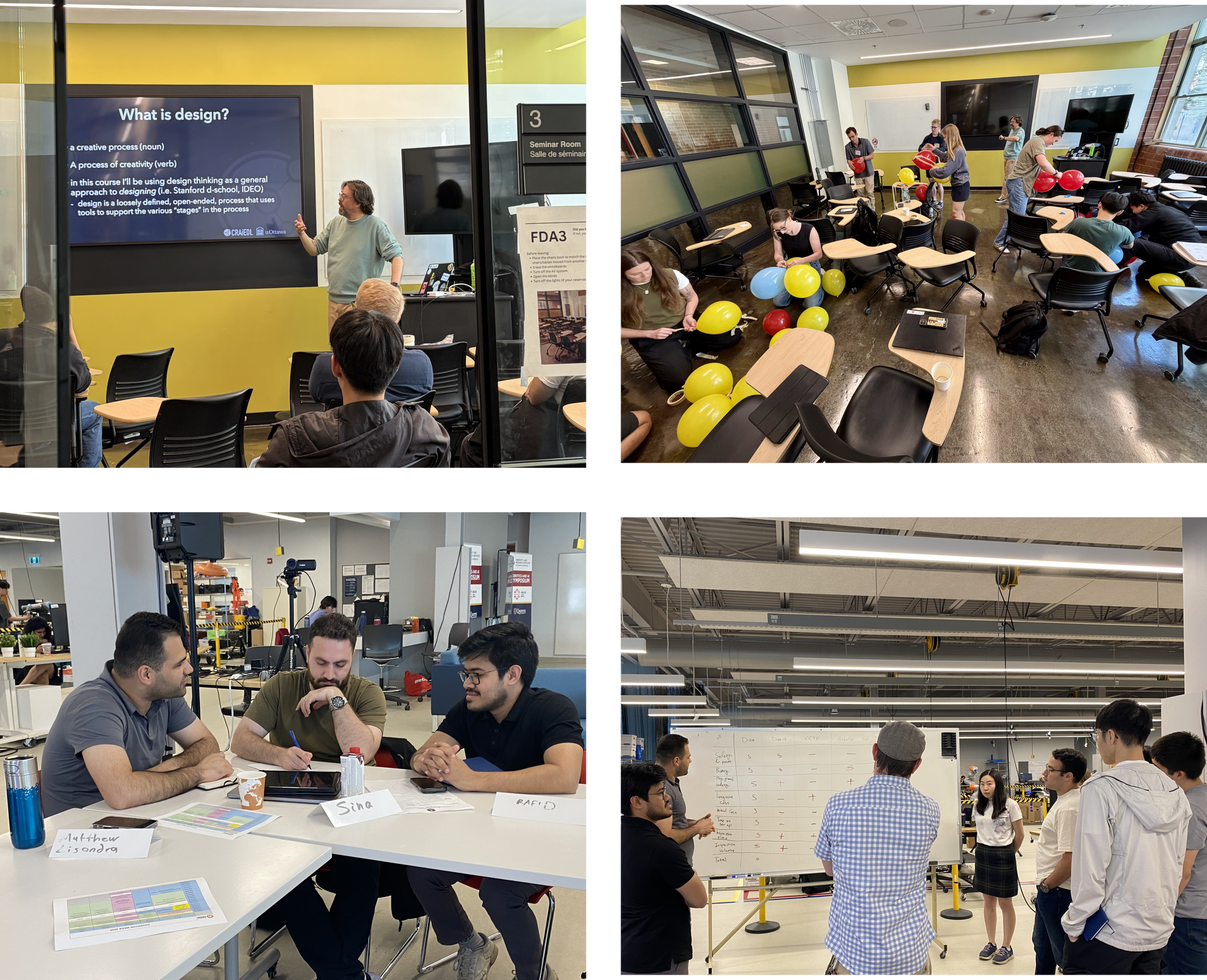
This module features lecture, discussion, and creative components to introduce trainees to a framework and tools to integrate an ethical and human-centered lens in the design of robotic systems. Trainees will complete a series of rapid design activities to identify and address ethical issues, consider the effects of multi-stakeholder interactions, prototype solutions, and justify design decisions.
Led by: Jason Millar, Matthew Robertson, Amy Wu
This module introduces Human-Robot Interaction as a field: what it is, where it came from, and why interaction quality determines whether a robotic system succeeds or fails in practice. Spanning the social, physical, and computational dimensions of HRI, topics include the role of robot design, morphology, and social cues in shaping trust and legibility; the fundamentals of impedance control and compliant physical interaction for safe human-robot collaboration; the perceptual and technical dimensions of haptics; and the computational methods by which robots estimate and respond to human intent and state. Ethical considerations and real-world deployment contexts are woven throughout. By the end of the module, participants will have a grounded understanding of why the human side of any robotic system is as demanding a design problem as the robot itself.
Led by: Keyvan Hashtrudi-Zaad, Yue Hu, Goldie Nejat, Matthew Pan
Many, if not, most roboticists and engineers will create something of value for real-world applications. This short course focuses on intellectual responsibility to prepare participants to use, share, and protect their work. Throughout this engaging in-person module, participants are taken through the basics of intellectual property, trademarks and copyright, trade secrets, patents, and how they might see the highest value return from a given project, both financially and socially. Participants will learn to navigate the world of IP, commercialization, and research responsibly, effectively, and efficiently.
Led by: Joshua Marshall
This discussion-based module challenges trainees to think critically and examine their understanding, perspectives, and intentions as roboticists and engineers when implementing robotic technologies in workplaces. Through engaging discussions, and electric debates, trainees will uncover unique thought pathways to navigate ethical robotic implementation and what it means to everyone.
Led by: Jason Millar
This module contains dynamic and interactive content focused on the control of haptic simulation systems. These systems allow users to interact physically, in space, time, and touch, with virtual environments. Trainees will learn about the application and implementation of systems that bring the physical world into a digital one.
Led by: Keyvan Hashtrudi-Zaad, Hsiu-Chin Lin
This technical module features active participation from trainees as they are encouraged to leverage their learning most effectively and appropriately to estimate the position and orientation of an object. Trainees use models, math, algorithms, and data interpretations as compliments towards answering the question: where is the robot relative to its surroundings?
Led by: James Forbes
Professional Development Workshops
Unlike traditional graduate training programs, ADVENTOR wholly prepares our trainees for their future careers.
To encompass a diverse set of professional skills, trainees must complete yearly courses and workshops in ethics, entrepreneurship, Gender-Based Analysis (GBA+), and Indigenization, Equity, Diversity, Inclusion, and Anti-Racism (I-EDIAA).
Internal Only