David McLagan

David McLagan
Assistant Professor
To develop global strategies to reduce the impact of pollutants
Department of Geology and Geological Sciences; Environmental Studies
Faculty of Arts and Science
Assistant Professor
To develop global strategies to reduce the impact of pollutants
Department of Geology and Geological Sciences; Environmental Studies
Faculty of Arts and Science
Continuing Associate Professor
Department of Philosophy
Faculty of Arts and Science
Date
Wednesday September 18, 2024Location
69 Union St, Mitchell Hall, Room 395Robotic methods for environmental monitoring have been in development for many years. Getting to market has been challenging, not only due to the demands for equipment performance and reliability but also keeping costs contained. In this talk, Dr. Mike Lipsett will describe how research results were brought to commercial implementation by a company founded by his former students. Technical aspects of commercializations as well as the realities of a start up will be discussed.
Micheal Lipsett
Professor, Dept. Mechanical Engineering, University of Alberta
Michael Lipsett is a Professor in the Department of Mechanical Engineering at the University of Alberta in Edmonton, Canada, with a PhD in robotics from Queen’s University. He currently holds the Poole Chair in Management for Engineers; and he is Director of Innovation, Creativity, and Entrepreneurship programs for the Faculty of Engineering. Mike has held technical and leadership roles in several Canadian energy companies. His research interests are the reliability and sustainability of integrated energy operations, transportation systems, and other complex systems, with a focus on robotics and automation for inspection and diagnostics, and applications of machine learning for asset integrity management. He teaches in the areas of engineering design, engineering economics, computer modeling of engineering systems, operations management, and entrepreneurship. Mike is part of two startups, one related to robotics for industrial environmental monitoring, and the other related to satellite-based remote sensing for asset management and smart agriculture. Dr. Lipsett is a registered professional engineer in Alberta.
Assistant Professor
Civil Engineering
Smith Engineering
Date
Tuesday May 7, 2024Location
69 Union St, Mitchell Hall, Room 395
6G wireless systems are expected to offer ubiquitous connectivity in presently under-served areas, potentially provided by satellite- and space-based internet-of-things applications. In the search for enabling technologies to achieve these expectations, molecular communication is an important alternative to conventional electromagnetic based wireless communication. In this talk, we give a brief introduction to molecular communication, and discuss how it may be used to communicate in "wave-denied" environments, where connectivity is desired but wireless cannot be used. We also show that molecular communication can achieve surprisingly high information rates, theoretically unlimited and practically in the gigabit-per-second range, making it a compelling technology for 6G. We finish with a discussion of the current state of the field and propose some experimental next steps.
Prof. Andrew Eckford
Associate Professor, Dept. of EECS, York University
Senior Fellow, Massey College
http://eckfordlab.org/
Andrew Eckford is an Associate Professor in the Department of Electrical Engineering and Computer Science at York University, Toronto, Ontario. His research interests include the application of information theory to biology, and the design of communication systems using molecular and biological techniques. His research has been covered in media including The Economist, The Wall Street Journal, and IEEE Spectrum. His research received the 2015 IET Communications Innovation Award, and was a finalist for the 2014 Bell Labs Prize. He is also a co-author of the textbook Molecular Communication, published by Cambridge University Press.
This seminar is open to the general public with free admission, pizza and refreshments.
For more information, please contact Dr. François Chan, chan-f@rmc.ca
Assistant Professor
Cloud Computing, High Performance Networks, Low-level Hardware-software Interfaces, Message Passing, High Performance Computing (HPC), Power/Energy Management of Extreme-scale Systems
Electrical and Computer Engineering
Smith Engineering
Assistant Professor
Systems and Networks
School of Computing
Faculty of Arts and Science
Date
Thursday April 18, 2024Location
69 Union St, Mitchell Hall, Room 395The Role of the Trunk in the Stability and Energetics of Locomotion
Human bipedal walking can be both stable and energetically efficient in complex environments. Previous research has primarily focused on the role of the lower limbs, and little is known about how the trunk contributes towards gait stability and energetic efficiency. I will discuss how I addressed this gap through four novel studies that investigated the role of trunk in human gait. These studies encompass walking at very slow speeds, walking outdoors in winter and summer weather conditions, restricting stability strategies, and the energetic consequences of trunk lean. Each of these studies improve scientific understanding of how the trunk is controlled in order to maintain stability and energetic efficiency during walking, leading to more informed robot algorithms or training regimes for gait assistance and recovery.
Aaron Best is a PhD student at Ingenuity Labs working in the Biomechanics x Robotics Laboratory under Dr. Amy Wu. His research is on the fundamental strategy that humans use to avoid falling while walking. Aaron did his BASc in applied science at Queen's University and has recently defended his PhD thesis.
Date
Wednesday March 20, 2024Location
69 Union St, Mitchell Hall, Room 395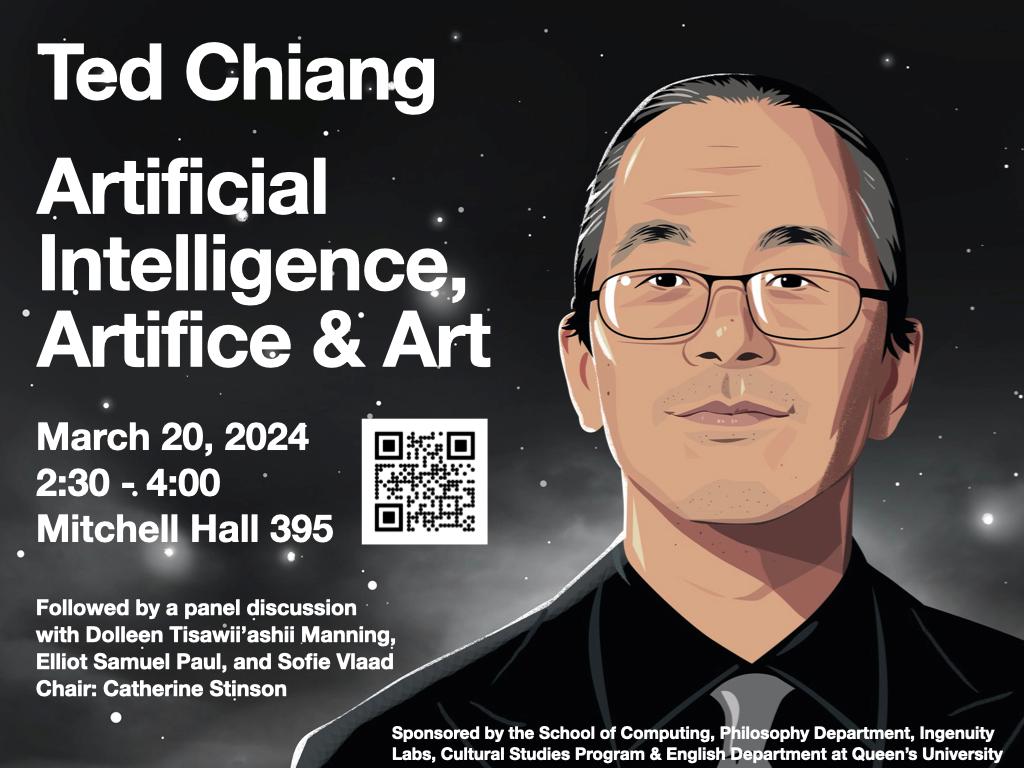
Ted Chiang: Artificial Intelligence, Artifice and Art
Does artificial intelligence deserve to be called intelligence? What are the uses of synthetic text and imagery, and what would it take for those to be artistic mediums?
Ted Chiang has been described as the greatest living science fiction writer. His stories have won 4 Hugo awards, 4 Nebula awards, and 6 Locus awards. The Denis Villeneuve film Arrival is an adaptation of Chiang’s "Story of Your Life". Chiang is also a frequent contributor to the New Yorker Magazine, and was named one of Time's 100 most influential people in AI.
Please register here for tickets: https://www.eventbrite.ca/e/ted-chiang-ai-artifice-and-art-tickets-859150421037
Thanks to the School of Computing, Philosophy Department, Ingenuity Labs, Cultural Studies Program, and English Department for sponsoring this event.
Date
Tuesday April 9, 2024Location
69 Union St, Mitchell Hall, Room 395Supercomputing at Sandia Overview
The talk will open with an overview of Sandia National Laboratories by Whit Schonbein. Sandia is one of the largest research laboratories in the world, and their use of Supercomputing over many years. This is meant to be very accessible and demonstrate to the audience the many uses of supercomputing and its emerging use in AI.
Leveraging high-performance data transfer to offload data management and analysis tasks to DPUs
Network interface controllers (NICs) with general-purpose compute capabilities (SmartNICs) present an opportunity for reducing host application overheads by offloading tasks that are not central to the execution of the target application to a SmartNIC. In this talk, we will discuss the role of SmartNICs in high performance computing (HPC) and then describe our approach for leveraging SmartNICs to offload data management and analysis tasks.
Data management and analysis plays a critical role in our application workflows. Our applications generate enormous amounts of complex data that require analysts to apply powerful tools for analysis and visualization. Offloading tasks associated with these tools to a SmartNIC has the potential to free up host resources that can be exploited to advance the target application. Effectively offloading tasks from host to SmartNIC also requires the host data associated with the offloaded computation to be transferred to the SmartNIC. To address this need, we introduce a high-performance, general-purpose data movement service that facilitates the offloading of tasks to SmartNICs: the SmartNIC Data Movement Service (SDMS). SDMS provides near-line-rate transfer bandwidths between the host and NIC with minimal host involvement. Moreover, SDMS’s In-transit Data Placement (IDP) feature can reduce (or even eliminate) the cost of serializing data on the NIC by performing the necessary data formatting during the transfer. We also present an in-depth case study based on Apache Arrow to demonstrate how SDMS can used effectively to offload data transformation operations.