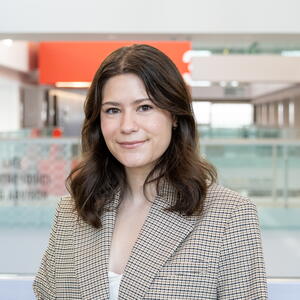
Ingenuity Labs Presents: Risto Ojala.

Date

Wednesday April 15, 2026
1:30 pm - 2:30 pm

Location

Mitchell Hall, Room 395

TIME CHANGED to 1:30 pm

Title:
Perception solutions for enabling automated driving in winter conditions.

Abstract:
This talk presents methods and findings from research on perception solutions for automated driving in winter conditions, carried out at the Autonomy & Mobility Laboratory, Aalto University. Winter conditions pose several challenges for automated vehicle perception pipelines, which currently limit the applicability of the technology in adverse weather conditions. The talk focuses on two main research directions: denoising snowflakes from LiDAR data and road segmentation in snowy conditions. Airborne snowflakes introduce significant noise into LiDAR scans, which can hinder downstream perception tasks. To address this challenge, the talk presents deep learning approaches for point cloud denoising based on both supervised and self-supervised learning. In addition, snowy conditions drastically alter the visual appearance of the environment and the road, rendering road segmentation methods trained on traditional datasets unreliable. To overcome this, trajectory-based approaches leveraging vision foundation models are presented for learning varied road appearance without requiring manual labelling.

Bio:
Risto Ojala, DSc (Tech) is an Assistant Professor at Aalto University, Finland, where he leads the Autonomy & Mobility Laboratory within the Mechatronics research group. His research focuses on intelligent vehicles and mobile robotics, with particular emphasis on perception, sensor fusion, and applied machine learning for autonomous systems. He is also currently a Visiting Scholar at Simon Fraser University, Canada, collaborating with the Multi-Agent Robotic Systems Laboratory on research in semantic understanding for mobile robotics. His work develops perception solutions that enable robust autonomous operation in challenging environments. A central application of his research is automated driving in winter conditions, addressing problems such as road understanding, situational awareness, and perception reliability. His work has been published in leading robotics and intelligent transportation venues and he collaborates closely with both academic and industrial partners.
Roboracer Race Day

Date

Saturday March 28, 2026
9:00 am - 2:00 pm

Location

Mitchell Hall, Room 395

This is a Tune Up Race for our Canadian Roboracer teams ahead of the big event at ICRA in June.

Robotics and AI Symposium 2026

Date

Wednesday October 14, 2026
9:00 am - 5:00 pm

Our annual Robotics and AI Symposium will be held again on Wednesday, October 14, 2026. 

Please have a look at our main RAIS2026 event page for details and registration.

We're looking forward to seeing you here in Kingston in October!

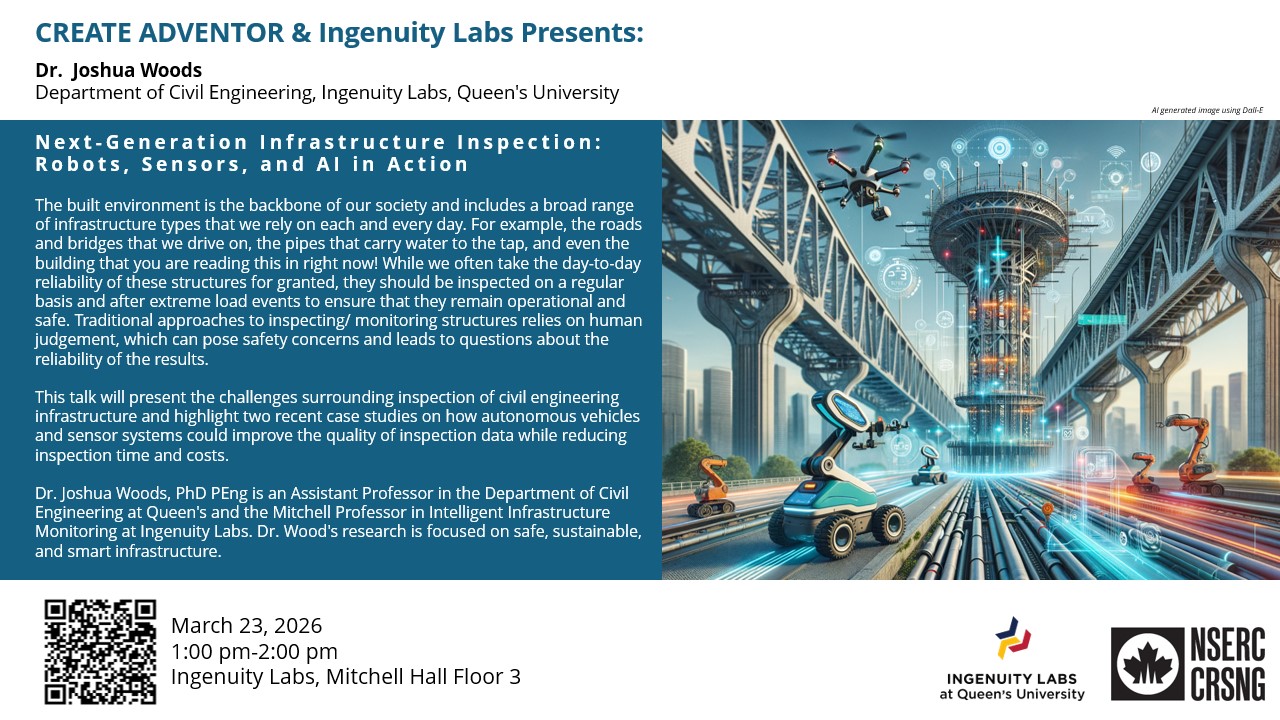
CREATE ADVENTOR & Ingenuity Labs Presents: Dr. Joshua Woods

Date

Monday March 23, 2026
1:00 pm - 2:00 pm

Location

Hybrid- 69 Union St, Mitchell Hall, Room 395

Event poster for Dr. Joshua Woods


Join us in person, or online for a talk by Dr. Joshua Woods from Ingenuity Labs, and the Department of Civil Engineering at Queen's University. 

Virtual Meeting


Biography

Dr. Joshua Woods, PhD PEng is an Assistant Professor in the Department of Civil Engineering at Queen's and the Mitchell Professor in Intelligent Infrastructure Monitoring at Ingenuity Labs. Dr. Wood's research is focused on safe, sustainable, and smart infrastructure. 


Next-Generation Infrastructure Inspection: Robots, Sensors, and AI in Action

The built environment is the backbone of our society and includes a broad range of infrastructure types that we rely on each and every day. For example, the roads and bridges that we drive on, the pipes that carry water to the tap, and even the building that you are reading this in right now! While we often take the day-to-day reliability of these structures for granted, they should be inspected on a regular basis and after extreme load events to ensure that they remain operational and safe. Traditional approaches to inspecting/ monitoring structures relies on human judgement, which can pose safety concerns and leads to questions about the reliability of the results. This talk will present the challenges surrounding inspection of civil engineering infrastructure and highlight two recent case studies on how autonomous vehicles and sensor systems could improve the quality of inspection data while reducing inspection time and costs. 


Ingenuity Labs & School of Comuting Present: Dr. Sheila McIlraith

Date

Thursday March 12, 2026
10:30 am - 11:30 am

Location

69 Union St, Mitchell Hall, Room 395

Title: How (formal) language can help AI agents learn, plan, and remember.

Abstract:

Humans have evolved languages over tens of thousands of years to provide useful abstractions for understanding and interacting with each other and with the physical world. Language comes in many forms. In Computer Science and in the study of AI, we have historically used knowledge representation languages and programming languages to capture our understanding of the world and to communicate unambiguously with computers. In this talk I will discuss how (formal) language can help AI agents learn, plan, and remember in the context of reinforcement learning. I’ll show how we can exploit the compositional syntax and semantics of formal language and automata to aid in the specification of complex reward-worthy behaviour, to improve the sample efficiency of learning, and to help agents learn what is necessary to remember. In doing so, I argue that (formal) language can help us address some of the challenges to reinforcement learning in the real world.

Bio:

Sheila McIlraith is a Professor in the Department of Computer Science at the University of Toronto, a Canada CIFAR AI Chair (Vector Institute), and an Associate Director and Research Lead at the Schwartz Reisman Institute for Technology and Society. McIlraith is the author of over 150 scholarly publications in the areas of knowledge representation, automated reasoning, and machine learning. Her work focuses on AI sequential decision making, broadly construed, through the lens of human-compatible AI. McIlraith is a fellow of the Association for Computing Machinery (ACM), a fellow of the Association for the Advancement of Artificial Intelligence (AAAI), and a Schmidt Sciences AI2050 Senior Fellow. She and co-authors have been recognized with a number of honours for their scholarly contributions including the 2011 SWSA Ten-Year Award, the ICAPS 2022 Influential Paper Award, and the 2023 IJCAI-JAIR Best Paper Prize. She also catalyzed and continues to co-lead the University of Toronto Embedded Ethics Education Initiative (E3I).

CREATE ADVENTOR Presents: Dr. EunJeong Cheon

Date

Friday February 6, 2026
1:00 pm - 2:00 pm

Location

Hybrid- 69 Union St, Mitchell Hall, Room 395

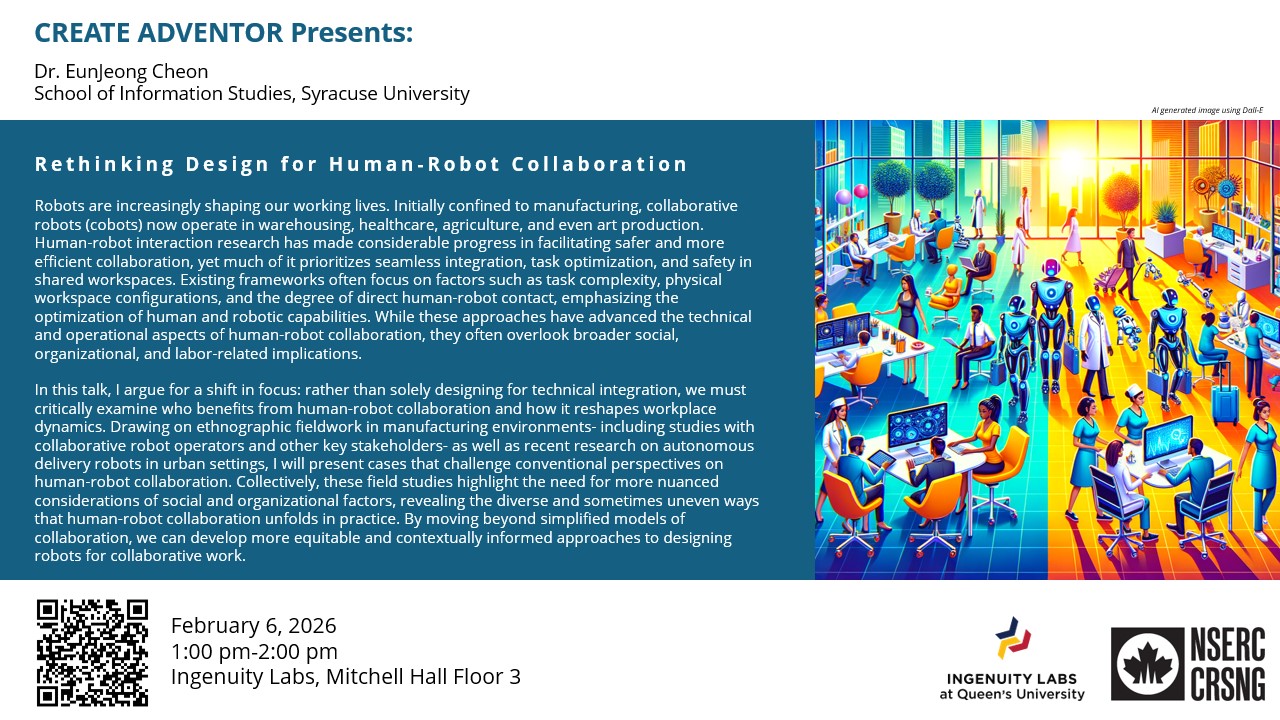
CREATE ADVENTOR Presents: Dr. EunJeong Cheon Poster


Join us in person, or online for this talk by Dr. EunJeong Cheon from the School of Information Studies at Syracuse University. This talk is open to the public. 

Virtual Meeting


Biography

EunJeong Cheon is an Assistant Professor in the School of Information Studies (iSchool) and a Senior Research Associate at the Autonomous Systems Policy Institute (ASPI) at Syracuse University. Her work in human-computer interaction explores the politics of emerging technology designs, including collaborative robots and labor-tracking AI systems. She focuses on human-robot collaboration in workplaces such as manufacturing and warehouse industries, as well as in creative domains like robotic art. More recently, she investigates autonomous delivery robots navigating urban public spaces. Through the lens of ethnography and design, and guided by questions from the humanities, she examines the politics and power dynamics that shape the relationships among technology, organizations, and humans. Her research has been published in top-tier conferences in HCI (e.g., ACM CHI, CSCW, DIS) and HRI (e.g., ACM HRI). Before joining Syracuse University, she was a tenure-track Assistant Professor in the Department of Computer Science at Aalborg University in Denmark.


Rethinking Design for Human-Robot Collaboration

Robots are increasingly shaping our working lives. Initially confined to manufacturing, collaborative robots (cobots) now operate in warehousing, healthcare, agriculture, and even art production. Human-robot interaction research has made considerable progress in facilitating safer and more efficient collaboration, yet much of it prioritizes seamless integration, task optimization, and safety in shared workspaces. Existing frameworks often focus on factors such as task complexity, physical workspace configurations, and the degree of direct human-robot contact, emphasizing the optimization of human and robotic capabilities. While these approaches have advanced the technical and operational aspects of human-robot collaboration, they often overlook broader social, organizational, and labor-related implications.


In this talk, I argue for a shift in focus: rather than solely designing for technical integration, we must critically examine who benefits from human-robot collaboration and how it reshapes workplace dynamics. Drawing on ethnographic fieldwork in manufacturing environments- including studies with collaborative robot operators and other key stakeholders- as well as recent research on autonomous delivery robots in urban settings, I will present cases that challenge conventional perspectives on human-robot collaboration. Collectively, these field studies highlight the need for more nuanced considerations of social and organizational factors, revealing the diverse and sometimes uneven ways that human-robot collaboration unfolds in practice.


By moving beyond simplified models of collaboration, we can develop more equitable and contextually informed approaches to designing robots for collaborative work. 


Sara Fraser

Head and shoulders portrait of Sara Fraser, CREATE ADVENTOR Program Coordinator

Sara Fraser

Research Coordinator

CREATE ADVENTOR: Advanced Engineering and Training in Next-Generation Mobile Robotics for Human Spaces

Ingenuity Labs Research Institute

Smith Engineering

Jason Millar

Head and shoulders photo of Jason Millar

Jason Millar

Associate Professor, Canada Research Chair in the Ethical Engineering of Robotics and AI

Ethical Engineering of Artificial Intelligence and Robotics

CREATE ADVENTOR Supervisor

School of Engineering Design and Teaching Innovation

Faculty of Engineering, University of Ottawa

Monica Castelhano

Head and shoulders photo of Monica Castelhano

Monica Castelhano

Professor, Chair of Cognitive Neuroscience Program

Primary research interests are in the visual attention and visual memory and how they function in our everyday lives

Department of Psychology

Faculty of Arts and Science