Ingenuity Labs Presents: Dr. Nasim Montazeri Ghahjaverestan

Date

Thursday August 14, 2025
10:30 am - 11:30 am

Location

Mitchell Hall, Room 395

Join us for this talk by Dr. Nasim Montazeri Ghahjaverestan

Sleep and Brain Health

Disrupted sleep is increasingly recognized not only as a consequence but as an early sign of underlying health issues. It has been linked to the onset and progression of neurological and chronic conditions, including dementia and epilepsy. In this way, sleep
serves as a vital indicator of brain health. To assess sleep, an intensive process is conducted inside specialized laboratories, involving the attachment of dozens of sensors to record physiological signals overnight. While effective, this method is costly,
limited to a single night's data, and often has long waitlists. Such inconvenient setup canbe intolerable for many populations, especially older adults or those with chronic illnesses. To improve sleep monitoring, wearables have become more widely adopted.
These systems offer convenience and long-term tracking, but often lack the accuracy and resolution needed for clinical decision-making.

This talk explores how artificial intelligence (AI)—particularly signal processing, machine learning, and sensor fusion techniques—can enhance the diagnostic power of wearable sleep data. By leveraging algorithms to extract meaningful patterns from noisy, low-resolution signals, AI can transform consumer-grade wearables into tools capable of supporting medical-grade insights. This intersection is high interdisciplinary and presents a rich area of innovation: from hardware design and embedded sensing to data
analysis, model interpretability, and clinical validation. The talk will highlight both the technical challenges and the opportunities to create AI-powered systems that can quantify sleep and help elucidate the complex links between sleep disruption and brain health.

Dr. Nasim Montazeri is an Assistant Professor in the Department of Electrical and Computer Engineering. Before joining Queen's, she was a postdoctoral fellow at the Sunnybrook Research Institute and University Health Network. She received a double PhD degree in signal processing and biomedical engineering from the University of Rennes 1 in France and Sharif University of Technology in Iran. Dr. Montazeri holds BSc degrees in biomedical and control engineering and a MSc degree in biomedical engineering. Dr. Montazeri was a woman entrepreneur and the co-founder of the BioSenseTex, a start-up company with expertise in developing innovative medical textile-based wearables. Dr. Montazeri was the recipient of several entrepreneurship awards, such as "Borealis AI/RBC" for her innovative research on analyzing respiratory system using acoustics and the Entrepreneurship for Cardiovascular Health Opportunities, ECHO" award for developing a textile-based sensor to measure lung edema in heart failure. To date her research has led to more than 40 journal article publications, conference presentations, abstracts and invited talks in major scientific venues such as American Thoracic Society (ATS), European Respiratory Society (ERS), World Sleep Congress, IEEE-EMBS, IEEE-ISSPIT, and Canadian Consortium on Neurodegeneration in Aging (CCNA). Her research interests include the development of medical wearables that promote remote health monitoring, the analysis of health data, and the use of artificial intelligence in healthcare—more specifically in sleep.  
 

Ingenuity Labs Presents: Dr. Jessica Burgner-Kahrs

Date

Thursday July 24, 2025
10:00 am - 11:30 am

Location

Mitchell Hall, Room 395

Join us for this talk by Dr. Jessica Burgner-Kahrs from the University of Toronto.

Physical and Computational Intelligence in Continuum Robotics

Continuum robots, with their slender, compliant bodies and intrinsic dexterity, offer unique capabilities for navigating and operating in constrained, cluttered, and deformable environments. Their ability to bend, twist, elongate, and conform enables curvilinear motion and environmental interaction in ways that rigid-link robots cannot replicate. These characteristics make them ideal for tasks ranging from minimally invasive surgery to inspection and repair of complex industrial systems, including turbomachinery found in power generation and propulsion, such as water turbines in hydroelectric plants. Yet, these capabilities come with substantial challenges: the need for novel actuation schemes, efficient and accurate models of their nonlinear behaviour, and robust state estimation under severe sensing limitations. In this talk, I will present our recent advances in the design and control of tendon-driven and soft continuum robots. I will discuss how physical intelligence—the purposeful embodiment of functionality in morphology and material—enables new robot designs that offload computational complexity to the body. In parallel, I will present how computational intelligence, through model-based estimation and control, complements embodiment by extracting and leveraging structure from sparse data and uncertain environments. Together, these approaches enable robust operation and decision-making in real-world settings, advancing continuum robotics toward broader deployment.

Jessica Burgner-Kahrs is Professor with the Departments of Mathematical & Computational Sciences, Computer Science, and Mechanical & Industrial Engineering, the founding Director of the Continuum Robotics Laboratory, and Associate Director of the Robotics Institute at the University of Toronto, Canada. She received her Diplom and Ph.D. in computer science from Karlsruhe Institute of Technology (KIT), Germany in 2006 and 2010 respectively. Before joining the University of Toronto, she was Associate Professor with Leibniz University Hannover, Germany and a postdoctoral fellow with Vanderbilt University, USA. Her research was recognized with the Heinz Maier-Leibnitz Prize, the Engineering Science Prize, the Lower Saxony Science Award in the category Young Researcher, and she was entitled Young Researcher of the Year 2015 in Germany. She was elected as one of the Top 40 under 40 in the category Science and Society in 2015, 2016, and 2017 by the business magazine Capital and elected one of 100 Young Global Leaders from the World Economic Forum in 2019. Jessica is a Senior member of the IEEE, a Distinguished Lecturer of IEEE RAS, and serves as a senior editor for IEEE RA-L.


Ingenuity Labs & CREATE ADVENTOR Present: Dr. Heather Knight

Date

Wednesday June 11, 2025
9:30 am - 10:30 am

Location

69 Union St, Mitchell Hall, Room 395

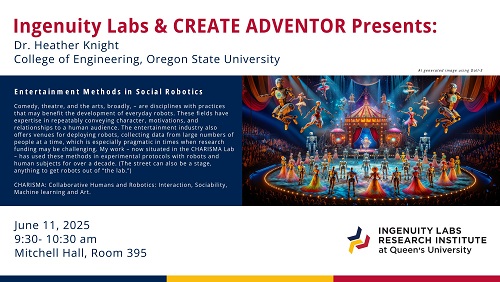
This is an AI generated colourful illustration of a performance with robots and humans on stage

Join us for this talk by Dr. Heather Knight. She will explain her research work with CHARISMA. This talk is open to the public.

Entertainment Methods in Social Robotics

Comedy, theatre, and the arts, broadly, – are disciplines with practices that may benefit the development of everyday robots. These fields have expertise in repeatably conveying character, motivations, and relationships to a human audience. The entertainment industry also offers venues for deploying robots, collecting data from large numbers of people at a time, which is especially pragmatic in times when research funding may be challenging. My work – now situated in the CHARISMA Lab – has used these methods in experimental protocols with robots and human subjects for over a decade. (The street can also be a stage, anything to get robots out of “the lab.”)

CHARISMA stands for Collaborative Humans and Robotics: Interaction, Sociability, Machine learning and Art. We develop robot behavioral software and interfaces that take humans into account as informed by the arts. Our past work considers expressive robots in many domains: from personal exploration (human-robot meditation retreats), to reimagining social settings (multi-robot furniture systems), to infusing robots in established cultural traditions (trick-or-treating robots), to artistic design (robot rehearsal software), to otherworldly entertainment (light equipped quadruped dance performances), to the dull, dirty, and dangerous work (intuitive controllers for robots to remove barnacles and maintain surfaces underwater). We have invented human-robot improv games, deployed multi-robot systems to run their own user studies, leveraged in-the-wild deployments to assess realworld robot systems, and produced a Robot Film Festival.

CHARISMA is powered by an interdisciplinary team of robot innovators, From undergrads to Ph.D. students to Artists-In-Residence. Our main research contributions are in Human-Robot Interaction and Social Robotics, two fields which seek to optimize the human-robot interface, integrating the fields of engineering, programming, electrical engineering, and psychology. This work has been recognized within academia (our work has over 1500 citations) and outside it (my work developing an expressive machine on a music video was recognized with a British VMA). We also develop robot rehearsal software and creatively intersect dance and acting with embodied intelligence.


Canadian Robotics Council Symposium 2025

Date

Thursday October 9, 2025
8:00 am - 5:00 pm

Location

Isabel Bader Centre

We're delighted to be hosting the 2025 Symposium for the Canadian Robotics Council at the Isabel Bader Centre. We are working on the details and will post program and registration information here soon. Pencil the date in your calendars!

Robotics and AI Symposium 2025

Date

Friday October 10, 2025
9:00 am - 4:30 pm

Location

Isabel Bader Centre

We are hosting our annual Robotics and AI Symposium (RAIS2025) on October 10, 2025. We will have more details soon. Pencil the date in your calendars!


Ingenuity Labs Presents: Dr. Karen Rudie

Date

Friday May 2, 2025
1:30 pm - 2:30 am

Location

69 Union St, Mitchell Hall, Room 395

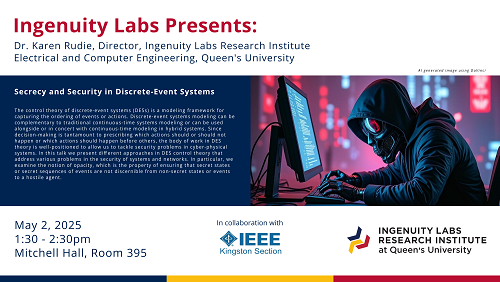
Poster for Karen Rudie talk with a picture of a nefarious man in a hoodie working on a computer. The image is AI generated

Join us for this talk by Dr. Karen Rudie, our Director. She will explain her research work in discrete-event systems and how it applies to secrecy and security applications. This talk is open to the public.

Secrecy and Security in Discrete-Event Systems

The control theory of discrete-event systems (DESs) is a modeling framework for capturing the ordering of events or actions. Discrete-event systems modeling can be complementary to traditional continuous-time systems modeling or can be used alongside or in concert with continuous-time modeling in hybrid systems. Since decision-making is tantamount to prescribing which actions should or should not happen or which actions should happen before others, the body of work in DES theory is well-positioned to allow us to tackle security problems in cyber-physical systems. In this talk we present different approaches in DES control theory that address various problems in the security of systems and networks. In particular, we examine the notion of opacity, which is the property of ensuring that secret states or secret sequences of events are not discernible from non-secret states or events to a hostile agent. We also look at cases where systems are attacked by adversarial agents that manipulate sensor outputs (i.e., event occurrences generated by a plant) so that a supervisor (i.e., a DES controller) is fooled into thinking the system is in some state that it is not in. We discuss the challenges of modeling security and secrecy problems using discrete-event systems.


Ingenuity Labs Presents: Dr. Hashima Hasan, Program Scientist, NASA

Date

Wednesday February 26, 2025
10:30 am - 11:30 am

Location

69 Union St, Mitchell Hall, Room 395

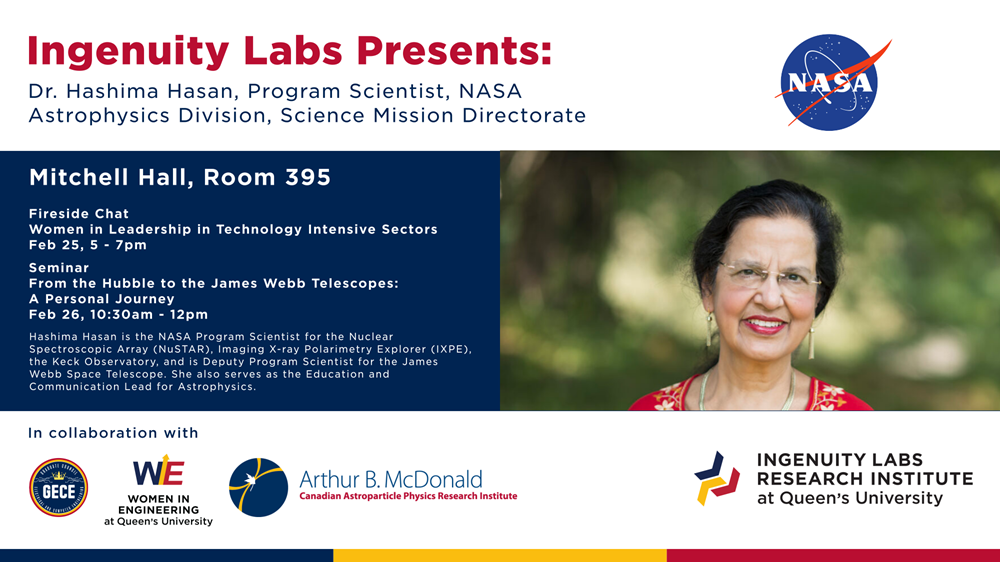
Event poster with an image of Dr. Hasan.

Please join us for this seminar as Dr. Hashima Hasan walks through her personal journey as a senior scientist on major NASA projects around developing and launching the Hubble and James Webb space telescopes. This event is open to everyone in the Queen's community. Seating is limited so please arrive early to secure a seat.

Ingenuity Labs Presents: Fireside Chat with Dr. Hashima Hasan

Date

Tuesday February 25, 2025
5:00 pm - 7:00 pm

Location

69 Union St, Mitchell Hall, Room 395

 Event poster for Dr. Hashima Hasan


Please join us for this fireside chat with Dr. Hashima Hasan to chat about her personal experiences as a female scientist in a male dominated industry. The talk will be hosted by Dr. Heidi Ploeg, Chair of Women in Engineering for Smith Engineering as well as Ruby Sinclair, a student in Mechanical and Materials Engineering.

Seating is limited in our space in Mitchell Hall, Room 395, so please arrive early to secure a seat.